
Cities for Childhood
Urbanism through the eyes of children: Building cities for autonomy and play.
Place
Santiago, Chile
Year
2024
Objectives
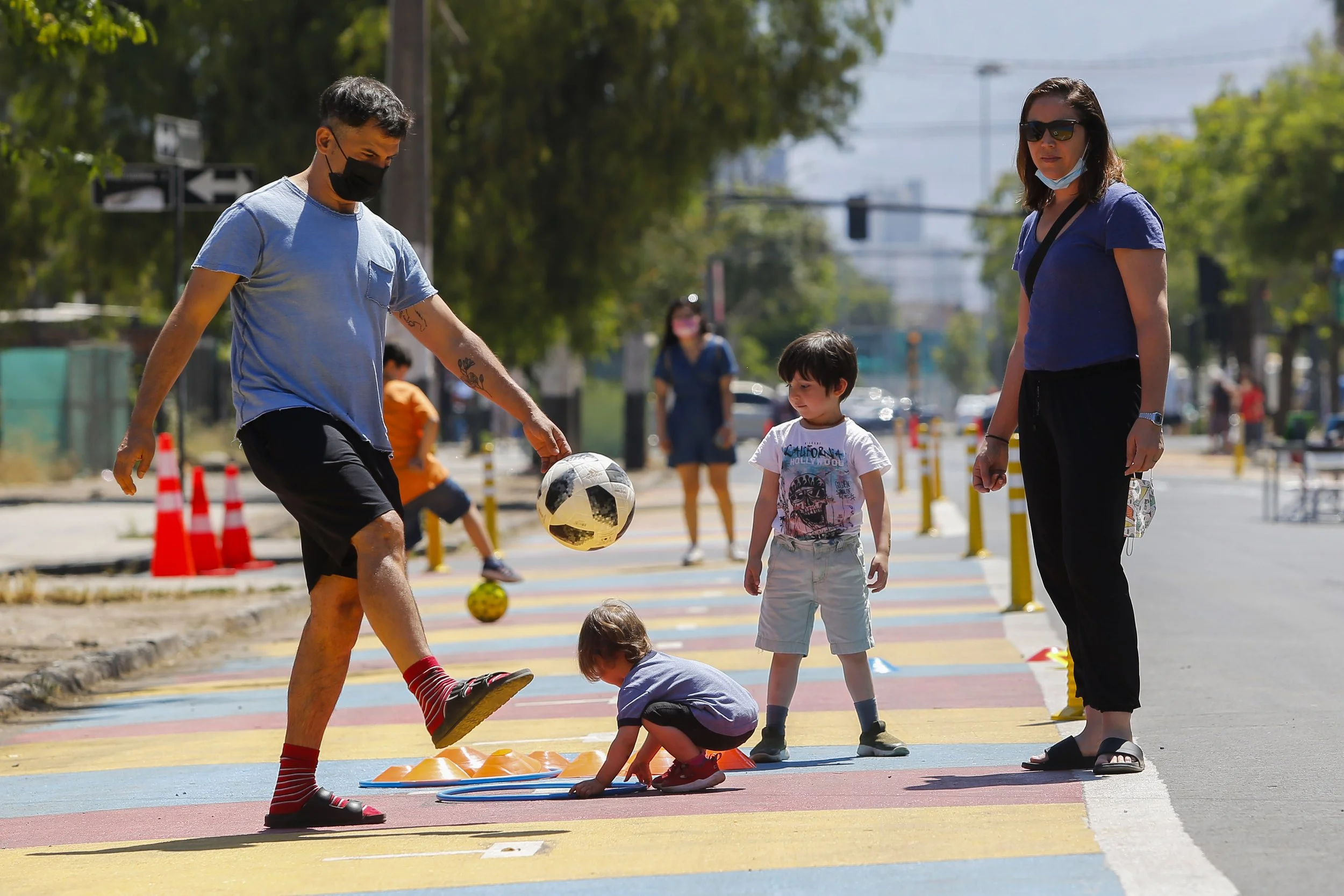
Transform the city into a safe and inspiring environment for children and their caregivers, promoting independent mobility.
Challenge the car-centric planning model that has restricted childhood freedoms and led to sedentary lifestyles.
Drive permanent changes in public space through experimentation and tactical urbanism.
Foster free play and urban exploration as pillars of holistic child development.
Methodology
The project is based on urban experimentation to build social capital and political will. It is developed in three fundamental stages:
Build by integrating the child’s perspective: Using participatory tools (drawings, photography, and dialogues) to understand how children perceive their environment and what improvements they propose from their unique perspective (at 95 cm tall).
Measure by involving others: Collecting data on the use of transformed spaces to demonstrate real impact to authorities and the community, facilitating project replicability.
Learn from results and experiences: Systematizing the evidence gathered to support permanent public policies and secure funding for long-term projects.
Clients / Partners
International Partners: Global Designing Cities Initiative (GDCI), ARUP (Streets for Kids and Proximity of Care initiatives), and the Bernard van Leer Foundation (Urban95 program).
Local Scope: Implemented by Ciudad Emergente in various Chilean municipalities, including Valdivia, Antofagasta, Independencia, Lo Espejo, and Cerrillos.
Results e Impact
Paradigm Shift: Successfully bringing cutting-edge international approaches to Chile, focusing on mobility and data-driven, human-centered design.
Health and Safety Impact: Directly addressing critical issues in Chile, where traffic accidents are the leading external cause of death for children aged 1 to 14, and only 15% commute actively to school.
Community Activation: Creating more playful and safe environments that invite families to reclaim the street as a meeting place, reducing perceived risk and promoting physical activity.
Conclusions
Planning a city for childhood is not just about building enclosed parks; it’s about turning the entire city into a playground where children can move freely. By improving the environment for a child, we improve the quality of life for all citizens. The success of these interventions is measured when, after the transformation, the community can answer with a resounding "YES" to whether they would let their children play in the street.